

Putaway is the warehouse activity of moving received goods from the receiving dock to their assigned storage location and recording that location in the warehouse management system (WMS). It is the step between goods receipt and storage, and it ends when the stock is both physically in place and system-visible as available.
Putaway decides two things: how quickly received stock becomes sellable, and how much work every later pick costs.
Importance of Putaway in Supply Chain
Putaway is often treated as a low-skill material handling task, which is why it is a frequent source of problems that surface elsewhere.
- Stock availability: Goods that are received but not yet put away cannot be picked. A warehouse holding stock on the dock is holding inventory it has paid for but cannot sell.
- Inventory accuracy: If an item is placed in a location other than the one recorded, it is effectively lost. Pickers report it as unavailable while the system shows stock on hand, which triggers unnecessary purchasing and failed orders.
- Picking cost: Where an item is placed determines how far every future picker walks to get it. Putaway decisions made in seconds are paid for over thousands of subsequent picks.
- Space utilisation: Poor putaway discipline produces part-filled locations, blocked aisles, and stock stored wherever there was room, which reduces usable capacity without reducing rent.
- Dock congestion: Slow putaway backs up the receiving area and delays inbound vehicle turnaround, which can attract detention charges.
- Traceability: For batch, lot, or expiry-controlled goods, putaway is where lot identity is bound to a location. An error here breaks FEFO rotation and recall capability.
Process of Putaway
- Receive and verify: Goods are checked against the purchase order for item, quantity, and condition, and lot, batch, serial, or expiry data is captured. Shortages, excesses, and damage are recorded before the stock is accepted.
- Stage: Verified goods are moved to a staging area while the system determines a storage location. Staging keeps the dock clear and separates verification from placement.
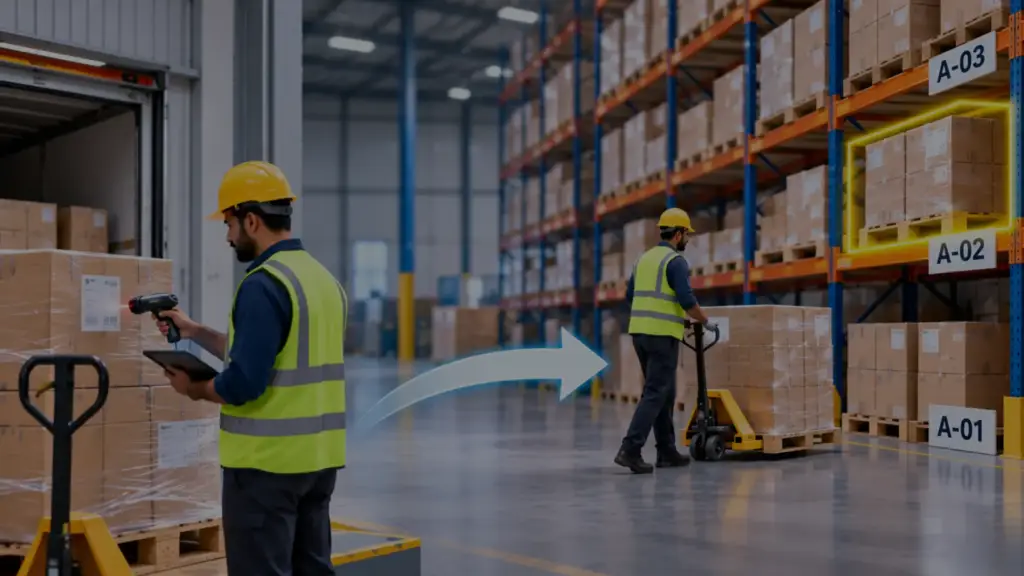
- Assign a location: The WMS selects a location using rules covering item velocity, unit size and weight, available capacity, handling or temperature requirements, and distance from the pick face.
- Transport and place: The operator is directed to the location and places the stock there.
- Confirm by scan: The operator scans the item or pallet and the location barcode. This closes the transaction, and only then does the system show the stock as available for picking.
Putaway strategies
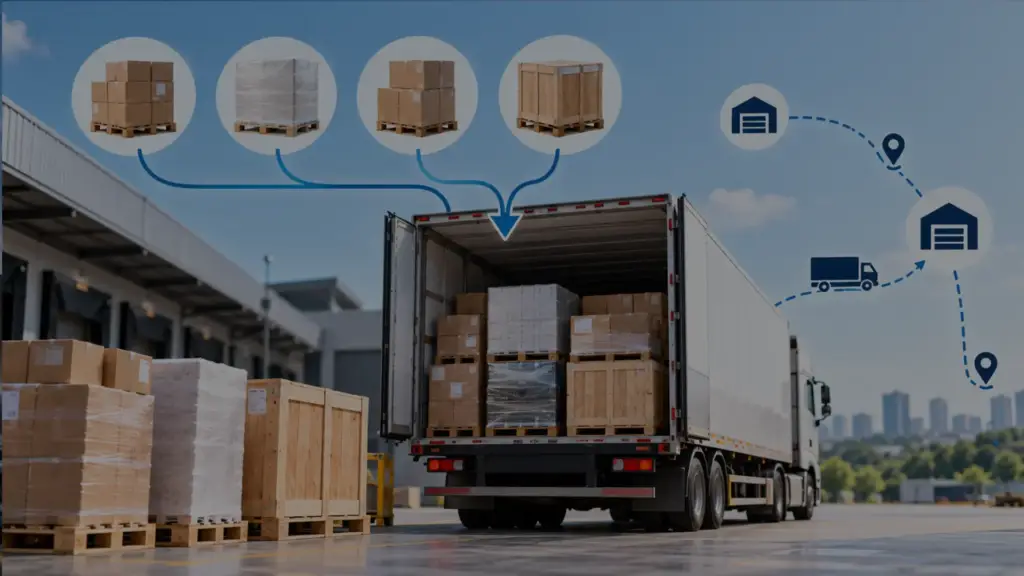
- Direct putaway: Goods go straight from the dock to a known final location, skipping staging. Fastest route, and the one used for pre-allocated stock and for cross-docked freight.
- Fixed location: Each SKU has a permanent home location. Simple for operators to learn and easy to audit, but wastes space when demand shifts, since the location sits reserved whether full or empty.
- Dynamic (random) putaway: The system assigns whichever suitable location is available at the time. Uses space far better, but depends entirely on accurate system records, because without them stock cannot be found.
- Zone putaway: Stock is placed by handling characteristic rather than by SKU, for example hazardous goods, cold storage, high-value cage stock, or oversized items.
- Directed putaway: The WMS calculates and instructs the location rather than leaving it to operator judgment. This is a layer applied over dynamic or zone strategies, and it is what makes dynamic storage workable at scale.
Most warehouses use a combination, for example direct putaway for fast movers and pre-allocated stock, dynamic putaway for the general range, and fixed locations for bulk or hazardous items.
What Are the Key Components of an Effective Putaway Process?
- Receiving verification: Confirms what actually arrived before it enters storage.
- Staging area: Buffer space between dock and storage.
- Location addressing: A consistent, labelled scheme for every storage position, which is the precondition for any system-directed putaway.
- Putaway rules: The logic the WMS applies to choose a location.
- Barcode or RFID scanning: Confirms item and location at placement. Unscanned putaway is where most location errors originate.
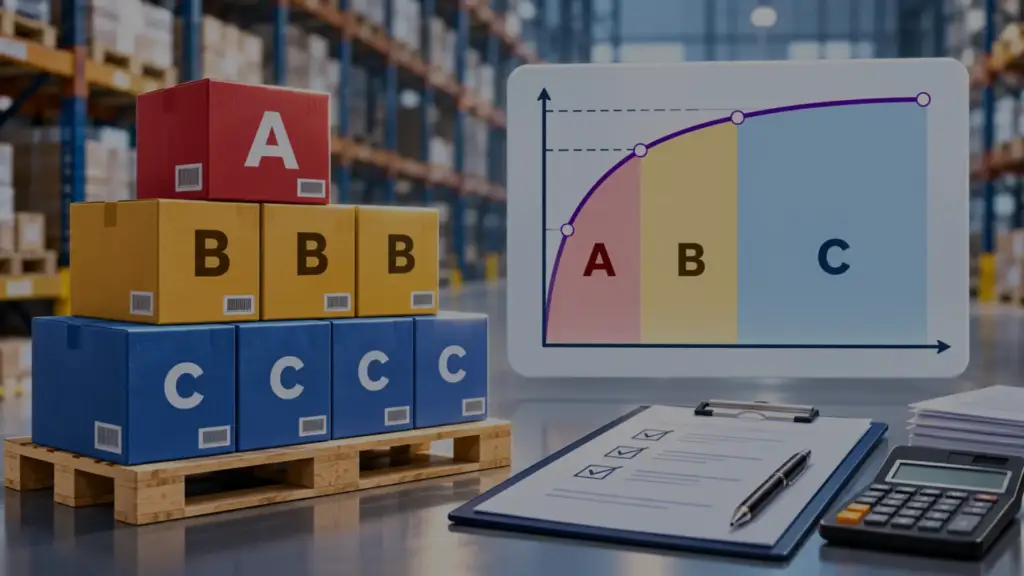
- Slotting: The periodic review of which items should sit where, based on pick frequency and item characteristics.
Practice in Putaway : A Warehouse Operations Example
A third-party warehouse in Bhiwandi receives 24 pallets of packaged goods in the morning.
Under its earlier method, operators placed pallets wherever space was visible and wrote the location on a sheet for later data entry. Dock-to-stock time averaged most of a day, and roughly one pallet in twenty was recorded in the wrong location, surfacing weeks later as a failed pick.
The warehouse moved to directed putaway. Goods are verified at receiving, staged briefly, and the WMS assigns each pallet a location based on the SKU’s pick velocity and the pallet’s weight, placing fast-moving items in lower racks nearer the dispatch end. The operator scans the pallet and the location on placement, which both confirms the position and makes the stock immediately pickable.
Dock-to-stock time fell to under two hours, misplacements became rare, and because fast-moving stock now sits closer to the pick face, picking travel time dropped as well without any change to the picking method.
Related Terms
- Pick and Pack
- Warehouse Slotting
- Dock-to-Stock Time
- Order Fulfilment
- Cross-Docking
- Cycle Counting
- Warehouse Management System (WMS)
- Inventory Management
Join The Community

Recent Glossary

FAQs
Q1. What is the difference between receiving and putaway?
Receiving is checking and accepting what arrived. Putaway is moving it to a storage location and recording that location. Stock can be received but not yet put away, in which case it exists on the books but cannot be picked.
Q2. What is directed putaway?
Putaway where the system calculates the storage location and instructs the operator, instead of the operator choosing. It is what allows dynamic storage to work without stock becoming unfindable.
Q3. Is fixed-location storage worse than dynamic?
Not inherently. Fixed locations are simpler, easier to learn, and well suited to bulk, hazardous, or very high-volume items. Dynamic storage uses space much more efficiently but requires disciplined scanning and reliable system data.
Q4 Why is dock-to-stock time measured?
Because stock sitting on the dock is paid for but unsellable. Dock-to-stock time is the clearest single indicator of whether putaway is keeping pace with receiving.