
(TAT) Turnaround Time in Logistics
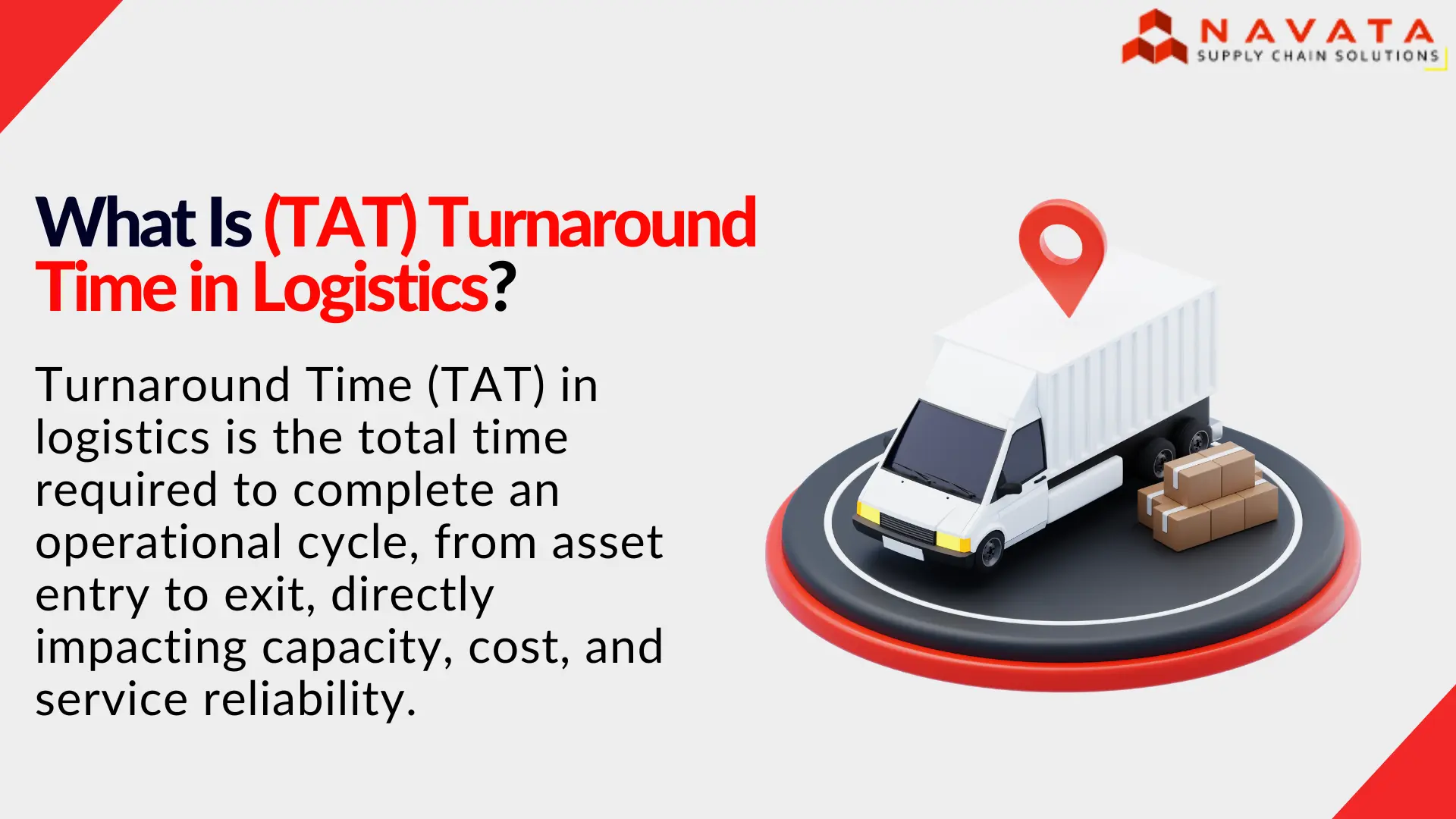
Turnaround Time refers to the total elapsed time required to complete a defined logistics activity from entry to exit. Unlike transit metrics, TAT focuses on what happens inside facilities and processes.
For example, when a truck enters a warehouse gate, TAT starts. It ends only when that truck exits fully loaded or unloaded, with documentation completed and clearance granted. Any delay in yard movement, dock allocation, loading, inspection, paperwork, or coordination extends TAT—even though the vehicle hasn’t moved an inch on the road.
This makes TAT one of the most honest indicators of operational discipline.
You May Like to Read: What Is Just-in-Case Inventory Management Strategy?
Where Turnaround Time Appears Across Logistics Operations?
TAT exists across nearly every logistics function, but its impact becomes most visible at critical bottlenecks.
In transport operations, vehicle turnaround time determines how many trips a fleet can realistically execute per day. Even small delays multiply across routes, reducing effective fleet capacity.
In warehousing, turnaround time governs how quickly inbound inventory becomes available for picking and how fast outbound orders leave the facility. Poor warehouse TAT often appears downstream as missed delivery promises.
In order processing, TAT reflects the time between order confirmation and shipment readiness. Delays here distort planning even before physical movement begins.
Each of these layers compounds the next, which is why TAT must be viewed end-to-end rather than in isolation.
What Actually Causes High Turnaround Time?
High TAT is rarely the result of one obvious failure. It emerges from misalignment between systems, people, and processes.
Common contributors include poor yard sequencing, unplanned arrivals, manual documentation dependencies, dock congestion, uneven labor deployment, and lack of real-time visibility. Individually, these issues seem manageable. Together, they create structural delays that no amount of fleet expansion can solve.
This is why adding trucks or manpower without fixing turnaround processes often increases cost without improving throughput.
Operational and Financial Impact of Poor TAT Control
When turnaround time expands, logistics systems lose elasticity.
Fleet utilization drops because vehicles spend more time idle than productive. Warehouses experience congestion as inbound and outbound flows overlap. Service-level commitments become fragile, forcing teams into constant escalation and firefighting.
Financially, high TAT drives detention charges, overtime costs, missed delivery penalties, and inefficient capital use. Strategically, it limits scalability—because growth magnifies inefficiencies rather than absorbing them.
In most cases, organizations discover TAT problems only after costs rise or customer trust erodes.
Why Reducing TAT Delivers Disproportionate Gains?
TAT reduction is one of the few improvements that increases capacity without adding assets.
When vehicle turnaround improves, the same fleet executes more trips. When warehouse turnaround tightens, order velocity increases without expanding space. When process turnaround stabilizes, planning becomes predictable instead of reactive.
This is why mature logistics networks focus on time compression, not asset accumulation.
Measuring TAT the Right Way
Effective TAT measurement requires discipline. It is not enough to calculate averages.
Each turnaround cycle must have clearly defined start and end points. Time must be captured at every operational stage. Delays must be traced to root causes, not symptoms.
Technology helps, but TAT improvement ultimately depends on process ownership and execution discipline—not dashboards alone.
TAT as a Leadership Metric
Turnaround Time is not just an operational KPI—it is a management signal.
Improving TAT indicates stronger coordination between transport, warehousing, and planning. Worsening TAT signals hidden friction long before service failures or cost overruns become visible.
Leaders who track TAT understand where capacity is truly being lost—and where control must be restored.

Read About: What is Inventory Management?
Conclusion
Turnaround Time defines how efficiently logistics systems convert assets into outcomes.
It determines whether fleets are productive or idle, whether warehouses flow or congest, and whether growth leads to scale or instability. Organizations that actively manage TAT gain control over cost, reliability, and capacity. Those that ignore it often mistake expansion for improvement.
In logistics, speed matters—but turnaround time decides performance.
Thanks For Reading: What Is (TAT) Turnaround Time in Logistics?
Powered By 360Presence