
Digitalisation, AI, automation — these are some of the most talked-about topics in supply chain today. But how much of it is actually solving real problems on the ground?
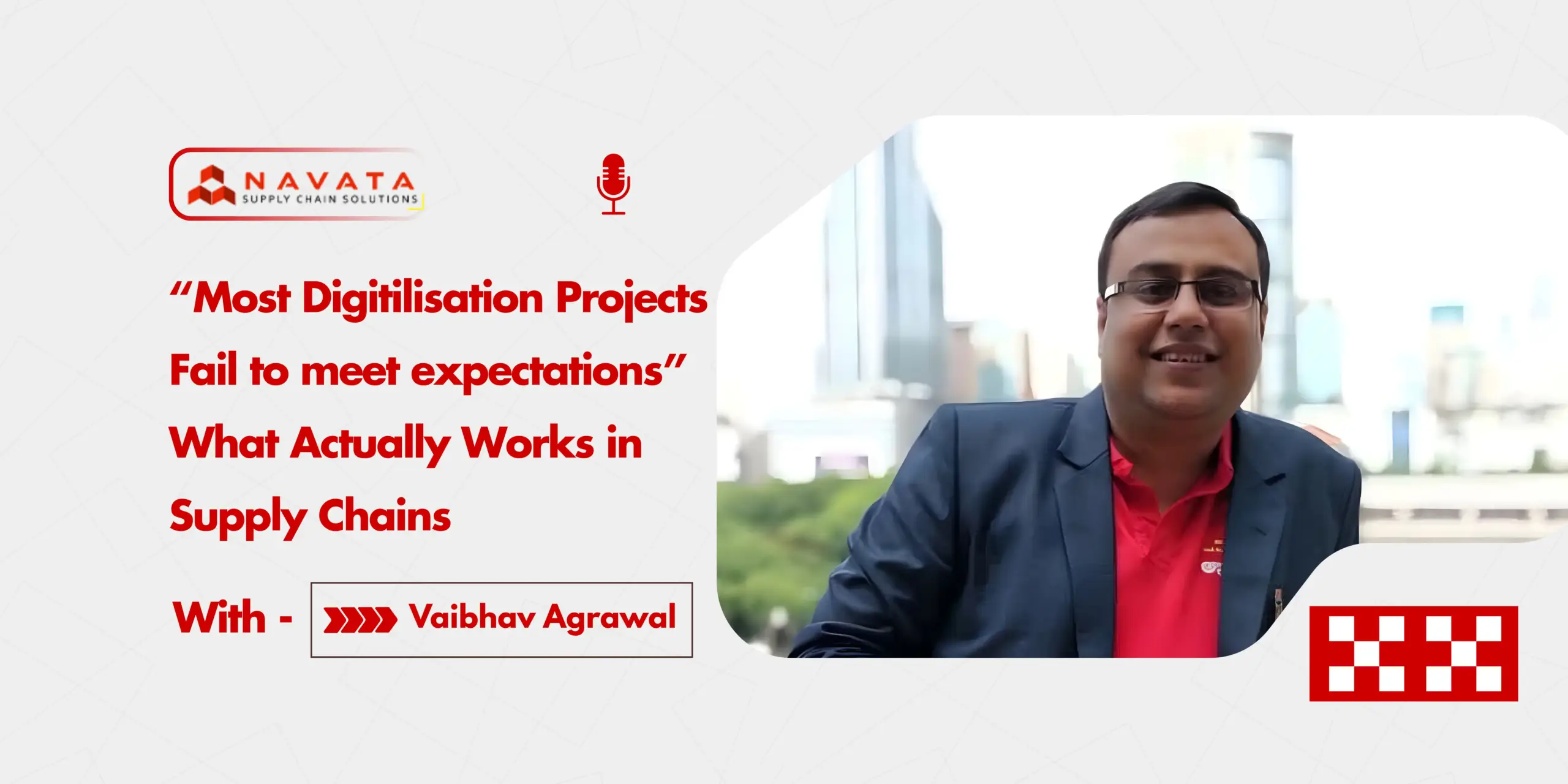
In this conversation with the Supply Chain Growth Hub, Vaibhav Agrawal breaks down what really works — and what doesn’t — when it comes to building practical, scalable supply chains.
Having worked in multiple leadership roles across FMCG and electrical supply chains, Vaibhav brings a deeply operational perspective — one that focuses not just on technology, but on clarity, adoption, and execution.
Q1. You’ve been part of multiple digitalisation initiatives. What are the biggest challenges you’ve seen?
See, according to me, digitalisation is a journey. It is not an end state. It is about how you start using data to make decisions.
Lets start understanding the areas where typically these projects fail.
First : Lets do what others are doing:
The biggest challenge companies face is a lack of clarity about identifying the real issue. You need first to understand what you want to do and why you want to do it. Many times, companies want to do it because everyone else is doing it. That’s the wrong approach.
For example, Companies might want visibility of vehicles . But The question is , why? Why do they really need it? What problem are they solving? Can digitalisation solve it? This lack of clarity is the biggest challenge.
Second : Cost Assumptions
The second biggest challenge is assumptions taken while justifying cost or business
Once you identify a need and you feel digitalization can solve it, then you try to build a business case. But what happens is we take a theoretical approach and build a business justification around it.
We forget that reality can be very different from theory, and we may not realize all the savings that we think we will. So it is very important to understand business realities and build justification based on that.
The third challenge is keeping the end state in mind.
Example, If you are digitalising your transportation system, what do you want to see? What is the success criteria ?
From day one, you should define:
- What KPIs will it improve
- What other area will be impacted
- How you will measure them
And start measuring from day one.
When the CEO or CFO starts asking these questions, most supply chain managers don’t have answers.
Fourth is ,data quality:
I have seen companies where the same data is pulled from three different sources, and all three are different.
So data quality becomes very, very important.
Because digitalization means two things:
- Data generation
- Data utilization
If your data is wrong, your decisions will be wrong.
Imagine a situation where the forecasting is done on a wrong historical sales data.
Fifth is integration:
A lot of companies have legacy systems, and those systems are not ready to integrate with new digital tools. That creates a big challenge.
Next and sixth is change management : — which I feel is one of the biggest problems.
You can implement any system, but if people on the ground don’t use it, it fails.
According to what I have seen, Adoption is the single most critical thing that makes and breaks a digitization project.
I actually work a lot in adoption — helping companies ensure that grassroots users adopt the system.
And finally the seventh area is, process standardization.
Many companies start digitalizing without standardizing processes.
For example, if you have 10 warehouses and each warehouse works differently, and you try to digitalize that — it will fail.
First, you standardize processes. Then you digitalize.
Otherwise, failure is guaranteed.
Q2. Can you share an example where digitalization didn’t solve the actual problem?
One of my clients wanted to implement a visibility solution because they suspected theft in their transportation network.
Their belief was simple: more visibility = problem solved.
In fact, they were on the verge of finalizing a large TMS investment with a reputed vendor.
But when we dug deeper, the real issue turned out to be very different.
The theft wasn’t due to a lack of visibility.
It was happening at the last mile.
Drivers were siphoning off stock, and the real gap was in the Proof of Delivery (POD) process—where PODs were being manipulated after customer sign-off.
So the core problem wasn’t visibility.
It was POD integrity.
And no visibility solution would have solved that.
Without implementing an ePOD system with proper controls, the issue would have continued—just with better dashboards.
They were about to invest heavily in the wrong solution.
This is exactly what I mean when I say:
Most organizations don’t have a clear understanding of problem. They have a problem-definition problem.
Its like having a Key, and then finding the lock that we can open with it.
Subscribe to Growth Hub for more in-depth industry leader interviews.
Q3. We are living in the times of AI. How are you seeing it being implemented in real world supply chain?
“AI” is probably one of the most overused words today.
Almost anything with data and algorithms is being labeled as AI.
But in reality, true AI means systems making decisions autonomously—on your behalf.
And we’re not quite there yet. At least, not at scale in India.
What we are actually seeing is a strong rise in machine learning and advanced analytics.
For example:
- In demand planning, companies are leveraging external signals like weather, seasonality, and customer sentiment to improve forecasts.
- In warehouse automation, most systems operate on predefined logic and algorithms—not autonomous intelligence.
- In route optimization, machine learning models suggest vehicle types and milk-run combinations based on historical data.
- In manufacturing, use cases like predictive maintenance, inventory optimization, and multi-echelon planning are becoming common.
All of these are powerful advancements.
But calling all of this “AI” is a stretch. These are all powerful, but I would still not call most of them AI.
Because until systems can independently make decisions, learn continuously, and adapt without human intervention—we’re still largely in the realm of machine learning and analytics.
Q4. Can you share a warehouse problem you solved?
Let’s first understand what a warehouse does.
It receives stock, breaks bulk into smaller lots, stores it, and fulfils orders.
Warehouse is not just storage — it is an art and a science of Storage.
Two key things matter:
- Inventory control
- Throughput (how fast you fulfil orders)
In one cases i worked, client’s inventory accuracy was around 90%.
Now imagine — if you have ₹100 crore of stock, 10% inaccuracy means ₹10 crore at risk.
That is huge.
We implemented a good WMS.
After implementation:
- Inventory accuracy improved to 99.9%
- Productivity improved from 60–70 cases/hour to ~100 cases/hour
- Manpower reduced significantly
- We were able to automate operations
- Even move towards vertical storage
Many companies think WMS is a cost. I tell them to “Think Again”!
But if you choose the right system and implement it properly, you will save much more than what you spend.
Q5. What advice would you give to young supply chain professionals?
This is a very interesting question. Whenever i meet young students, who want to persue their career in Supply Chain, I tell them,
First, don’t come into supply chain for money. It’s not the highest-paying sector. Come only if you have passion.
Second, start from field roles. Get your hands dirty. That learning stays for life.
Third, understand numbers. Supply chain is all about data and taking quick decisions using this data
Fourth, understand cause and effect. Any decision you take impacts another part of the supply chain. A E2E understanding is absolutely necessary.
Fifth, learn to work with people. You will deal with drivers, warehouse staff, management — everyone.
And lastly, take quick decisions.
In logistics, if you wait for perfection, you lose the game.
Even if you are right 80–90% of the time, that’s good enough.